
Consumer wellness guide - 12 min read
How Should I Store and Care for Water-Based Lubricant?
Use a label-led checklist to store water-based lubricant upright, clean, private, and identifiable, with practical checks for package condition and support.
SEO title: How to Store Water-Based Lubricant | LuxoVibe Meta description: Use a label-led checklist to store water-based lubricant upright, clean, private, and identifiable, with practical checks for package condition and support. URL slug: /blog/how-should-i-store-and-care-for-water-based-lubricant Last reviewed: August 28, 2026
Quick answer
Store water-based lubricant in its original closed package, upright when practical, in the temperature and light conditions stated on its current label. Keep it clean, private, and easy to identify, then inspect the closure and package condition before relying on it. Do not treat a generic drawer routine as a substitute for the manufacturer's formula-specific instructions.
Introduction
A well-informed personal-wellness purchase is built from visible documentation, not broad advertising. This guide answers one specific water-based lubricant question with an adult-appropriate, non-prescriptive workflow. It separates general education from the facts that only the exact formula, package, seller policy, and product manual can provide.
A practical buyer records what is known, what is a preference, and what still needs an answer. The product title, current label, package size, directions, policy pages, and official support route belong in the evidence column. Preferences such as package style or preferred storage place stay separate. This prevents one vague statement from carrying more weight than it deserves.
*How Should I Store and Care for Water-Based Lubricant starts with current product information, not assumptions.*
What this guide covers
- Choose a stable, label-led storage place
- Keep identification and ownership records together
- Inspect before returning a stored product to the routine
The CDC condom guide says to use water- or silicone-based lubricant with external condoms and warns that oil-based lubricants can weaken latex. Planned Parenthood's overview describes water-, silicone-, and oil-based categories, while stressing that the right choice depends on the plan and the exact product. For online purchases, the FTC's online-shopping guidance recommends checking policies, reading reviews critically, and keeping order records. These sources inform general education only; the current label and instructions for the exact formula always control.
Choose a stable, label-led storage place
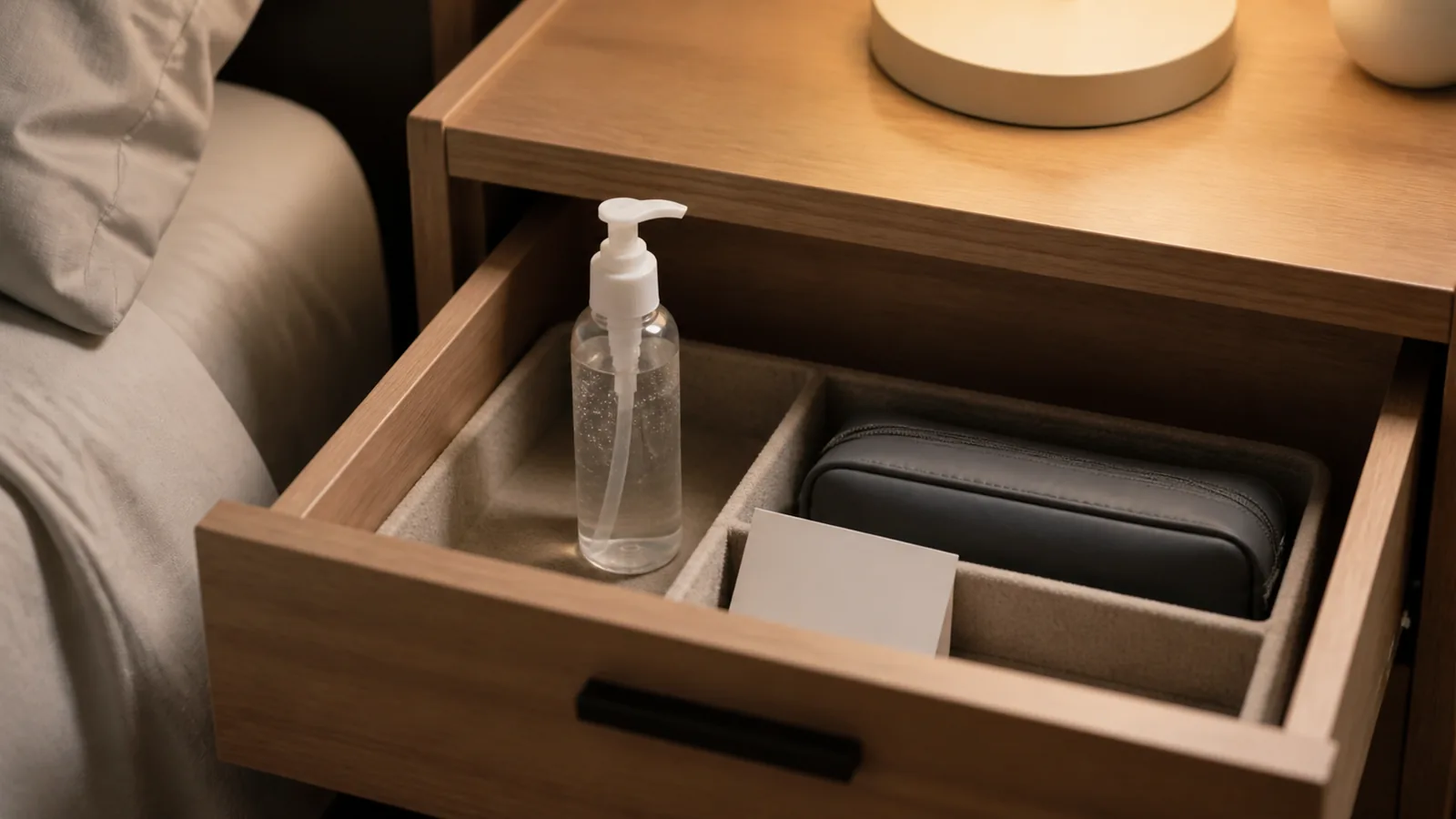
Start with the product's own storage statement. A clean, dry, private cupboard or drawer can be a sensible choice when it matches the instructions and keeps the bottle away from direct heat, sun, and avoidable spills. Stand a pump or flip-top package upright when practical, with the cap fully closed. A divided organizer can prevent the bottle from being knocked against sharp objects or confused with unrelated toiletries.
Do not use a parked car, a hot windowsill, or another location with changing conditions as an assumed storage place. A storage pouch can reduce dust and visual exposure, but it should not hide a leaking bottle or trap moisture around a package. The goal is an orderly routine that makes the label and condition easy to check, not a universal promise about shelf life.
Keep identification and ownership records together
The original bottle and carton, when available, retain key information: exact variant, directions, an expiry or lot code where supplied, and a support route. Keep the purchase confirmation and product link in a private digital folder. If multiple formulas are in the home, add a non-permanent organizer note outside the product instead of writing over the package or transferring contents.
This protects choices at the next purchase as well. A familiar silhouette does not prove that a formula or package has not changed. Before reordering, compare the current listing, package size, and ingredients or product information with the record you kept. If an important detail cannot be matched, ask before purchase rather than depending on an old receipt or review.
Inspect before returning a stored product to the routine
Storage care includes a short check. Look for a closed cap, intact package, unusual leaking, damage, or directions that indicate the item should no longer be used. Do not ignore a damaged hygiene seal because the bottle was stored privately. Keep the product separate from cleaning liquids, oils, or containers that could confuse the routine.
When using a formula with an adult-wellness product, handle the other item according to its own manual. Dry it fully after its recommended cleaning process, protect charging components, and store materials as directed. Storage is a sequence of small checks, not a performance claim about how any particular formula will behave.
Need one fact confirmed before you order? Contact LuxoVibe with the exact product and a focused question. Only share details needed to handle the inquiry; our Privacy Policy explains the contact context.
A repeatable buying and ownership checklist
Use this checklist before checkout and again when the order arrives:
- Identify the exact product, variant, volume, and seller.
- Save the current listing, directions, privacy page, delivery terms, and return policy.
- Read the formula and compatibility information together with the instructions for any related product or barrier.
- Choose a storage and cleanup routine that follows the label rather than a generic online tip.
- At delivery, check the item and outer packaging before breaking a hygiene seal.
- Retain order confirmation, support exchanges, and photographs of an observable issue.
- Pause the purchase when an essential fact cannot be documented.
The checklist is deliberately modest. It does not assume a product is appropriate for every person or circumstance, and it does not promise a performance outcome. It gives a buyer a way to ask clearer questions, compare current information, and avoid turning a missing fact into a risk.
Product application and care: keep sources separate
Product application is easiest to manage when each source keeps its role. The label explains the formula and package. A personal-wellness product manual explains its materials, seals, charging components, and cleaning limits. The policy pages explain shipping, privacy, returns, and support. An external health authority can explain a general category principle, but it cannot confirm the condition of the individual product on a buyer's shelf.
For example, do not infer that a product is waterproof, compatible with every material, suitable for a particular health circumstance, or covered by a warranty simply because a similar product has a review saying so. Use the exact product documentation. If two sources appear to conflict, stop and ask the seller which current instructions apply; do not choose the more convenient answer.
A practical decision record takes less than five minutes. Save the product URL and date, exact variant and volume, the directions you read, the policy links, and the support route. At delivery, compare the parcel and item with that record before opening any hygiene seal. This is a customer arrival check, not a claim about factory testing or shipment inspection. It simply preserves evidence if the wrong item, damaged package, leaking closure, or missing instructions need to be reported.
Keep the record focused. A listing photo is not ingredient documentation, a star rating is not a policy, and a category label is not a guarantee about a particular formula or a mixed-material product. When an answer matters to the order, ask the seller to identify the precise product and respond in writing. If the answer remains vague, waiting is a sensible purchase outcome.
How to turn a broad question into a useful product question
The strongest shopping questions identify one item and one decision point. Instead of asking whether a formula is simply "safe," ask which current document applies to the 100 mL pump variant, where its storage instruction appears, or whether the seller has a stated process for a package that arrives leaking. This wording gives support a chance to answer with a record that can be checked later. It also helps a buyer avoid treating a marketing word as a technical specification.
Use a small evidence table when comparing tabs:
| Decision point | Strong evidence | Weak evidence |
|---|---|---|
| Product identity | Current title, variant, package and directions | A cropped image or old social post |
| Formula information | Current label or official product source | A review of a different version |
| Compatibility | Exact barrier or product manual | A generic category claim |
| Delivery and privacy | Current policy pages and official response | Assumptions about discreet shopping |
| Return support | Written terms for the exact seller and item | Another store's policy |
A modest record is not bureaucracy. It lets a customer decide what is verified, what remains a preference, and what needs a reply before payment. It also avoids unnecessary disclosure: an order number and product name are usually enough for a factual support request. Do not include passwords, payment credentials, or intimate details in an inquiry.
Use delivery evidence without turning it into a dispute
If an outer parcel is visibly damaged, take a few clear photographs before opening the product. Capture the observable condition, retain the shipping and order information, and contact the official support route promptly. Keep the message descriptive rather than accusatory: say what arrived, what was visible, whether a hygiene seal has remained unopened, and what product the order listed. Follow the seller's written next step.
The same method applies to a mismatch between an order and a delivered item. Do not use, discard, alter, or decant the item while the applicable policy is being confirmed. A consumer can preserve evidence and still be fair about what is known: a damaged outer package does not prove the cause, and a support request does not guarantee a particular resolution. Current written terms and local consumer rules determine the available process.
Keep current documents with the item
Save the instructions and purchase record in a private place you can revisit. Before ordering a replacement, compare the current page with the package you kept: product names, sizes, ingredients or formula information where supplied, directions, and policy wording can change. This small check avoids relying on a past version. It also gives support a precise starting point if a question concerns the item currently in hand.
When to pause and ask for help
Pause before purchasing or using a formula when the product identity, directions, package condition, compatibility statement, policy route, or support contact cannot be confirmed. A price promotion, trend, or enthusiastic review is not a reason to fill a documentation gap. The same applies if an item arrives damaged, leaking, visibly altered, or without the information needed to identify it.
Do not use a commercial article as a medical assessment. Stop using a product and seek qualified clinical advice for persistent or severe discomfort, irritation, an unexpected reaction, or another health concern. Never rely on a damaged, leaking, expired, altered, or unidentifiable formula. Do not decant it into an unlabelled container or mix formulas in an attempt to create a new product.
Frequently asked questions
Can I keep water-based lubricant in a bathroom?
Only if the exact label allows the conditions there. Choose a clean, stable location away from heat, direct sun, and unnecessary moisture, and follow the storage statement for the product you own.
Should the bottle be kept upright?
An upright, fully closed package can make leaks easier to notice, but the label and package design control. Do not force a container into a position that its directions do not support.
Can I store several lubricants together?
You can organize identifiable, closed packages, but do not mix contents or rely on similar bottles. Keep each product's instructions and condition easy to inspect.
Conclusion
Store water-based lubricant in its original closed package, upright when practical, in the temperature and light conditions stated on its current label. Keep it clean, private, and easy to identify, then inspect the closure and package condition before relying on it. Do not treat a generic drawer routine as a substitute for the manufacturer's formula-specific instructions. A responsible decision does not require perfect certainty. It requires enough current, product-specific information to follow the product directions, manage the package, and know where to ask a question. Keep the essential record, compare facts rather than slogans, and leave a purchase open when a critical answer is missing.
Related resources
- Browse LuxoVibe's product catalog, read how to care for silicone sex toys, and review Privacy Policy for inquiry context.
- Read the CDC condom guide, Planned Parenthood lubricant overview, and FTC online-shopping guidance for general education.
Need help choosing a product direction?
LuxoVibe can clarify catalog information, current product documentation, and ordering questions before you decide. Browse the product catalog, review our Privacy Policy, or contact the team. Include only the information needed for the request.