
Consumer wellness guide - 12 min read
Prostate Massager Shape and Safety Base: What Buyers Should Check
Verify prostate-massager measurements, curve, external safety base, materials, care, and support through exact-model documentation.
Materials, Cleaning & Storage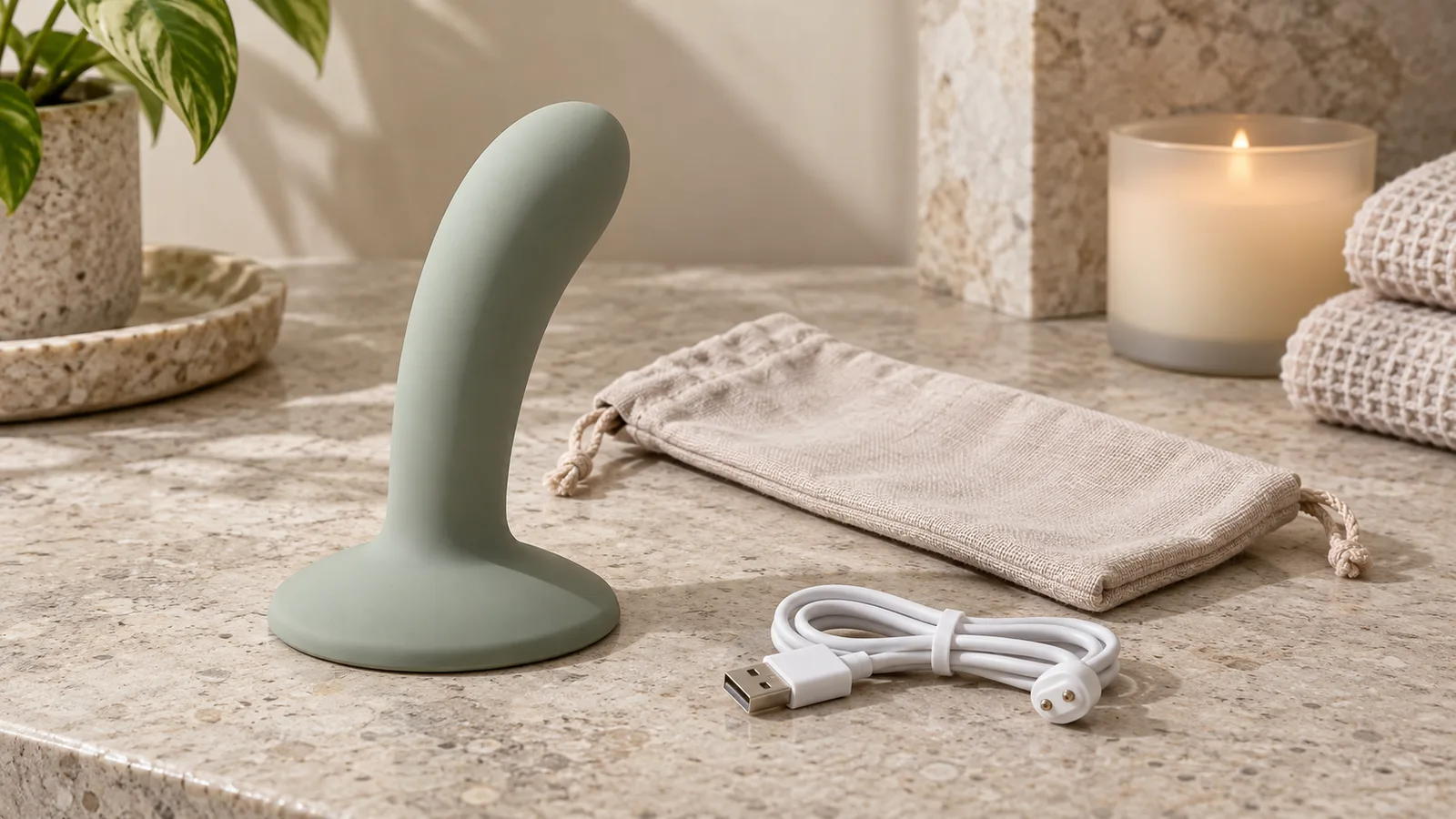
Need a documented answer?
Ask one focused product or sourcing question.
Tell our team the exact model, market, material, care, packaging, or quantity detail you need to confirm. We will help route your enquiry to the right next step.
SEO Title: Prostate Massager Shape and Safety Base Guide | LuxoVibe Meta Description: Learn what to verify about a prostate massager's shape, dimensions, external safety base, materials, care, and support before ordering. URL Slug: /blog/prostate-massager-shape-base-guide Last reviewed: September 23, 2026 Target keyword: prostate massager shape and safety base
Quick answer
When comparing prostate-massager shape, buyers should verify the exact model's stated insertable length, widest measurement, curve, external safety base or arm, materials, and instructions. An anal product needs a documented feature that remains outside the body; a photograph, "ergonomic" label, or curve alone is not proof. Missing safety or care information is a reason to stop and ask.
Introduction
Shape is the first thing a buyer sees and one of the easiest things to misunderstand. A silhouette may look modest in a lifestyle photograph, while the maximum width, neck, curve, external arm, and base dimensions tell a very different ownership story. Product pages also use loose words such as "contoured," "targeted," and "anatomical." These are descriptions, not measurements, and they do not establish a universal result, medical purpose, or suitable fit.
For prostate-focused products, compare the shape as an engineering and information question. Does the listing identify an insertable section and an external stop? Does it state the measurements that affect storage and handling? Does the manual show the current components? Do the product material and cleaning directions match that construction? A buyer should be able to answer these questions using a date-stamped listing and instructions, rather than needing to infer them from photos or reviews.
This guide does not offer medical advice. Cleveland Clinic says prostate massage has no demonstrated medical benefit and should not be used to self-treat a symptom. If the decision involves pain, bleeding, hemorrhoids, surgery, medication, infection, urinary symptoms, or another individual health issue, a qualified clinician is the right source. Product selection can wait.
The external safety feature is non-negotiable
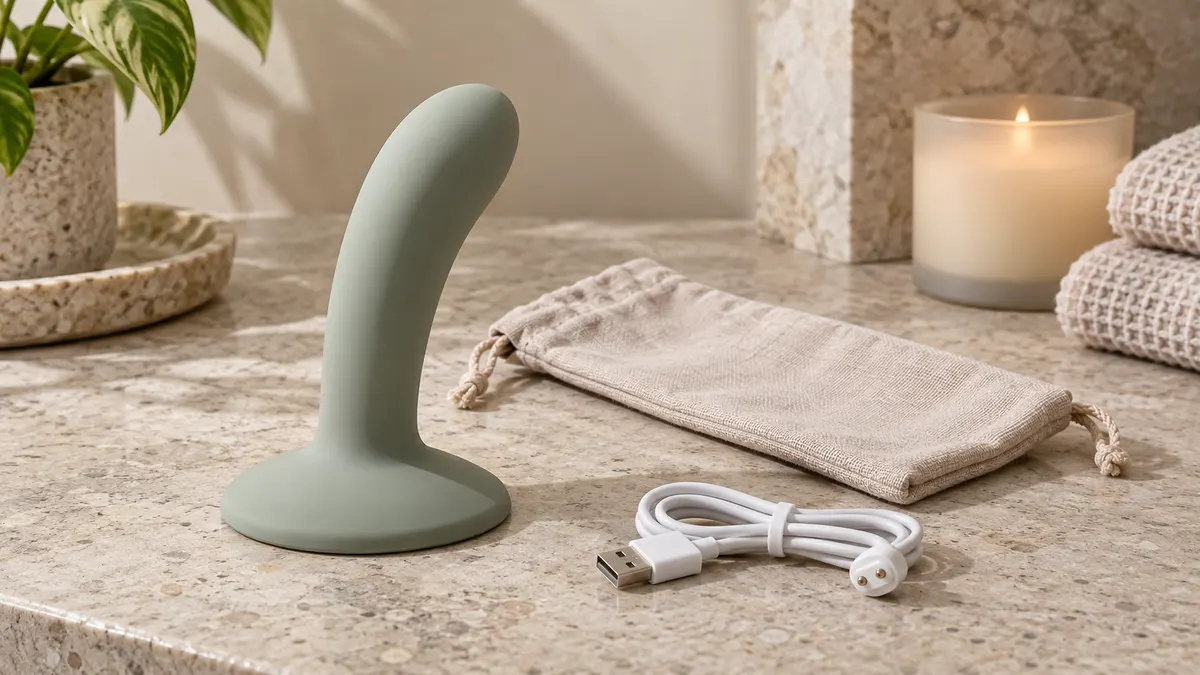
Planned Parenthood's consumer guidance is direct: any product used anally needs a wide base or another way to prevent it from moving all the way inside. On a prostate massager, that may be a flared base, a handle-like loop, or an external arm designed to stay outside. The particular design is less important than clear manufacturer information about the exact model. Do not treat a narrow handle, decorative tail, cable, removable cap, or product packaging as a substitute for a documented retention feature.
Look at the entire external section, not only its widest visible edge. A solid base can also house a control, charging contact, or perineum-facing arm; those components may have their own cleaning and storage limits. If the model has a removable part, confirm whether it is intended to remain in place during normal use and how the manual directs it to be cleaned or reattached. Never alter, trim, force, repair, or combine components from products to create a different shape.
The phrase "safety base" should not become an unverified claim about product testing or certification. In a consumer guide, it simply means buyers should select a product designed for its stated use, with an external feature that the current documentation identifies. Any specific certification or compliance statement must come from the actual manufacturer documentation for the exact item and market; do not assume one from category language.
| Shape detail | What to document | Why it affects the decision |
|---|---|---|
| Insertable length | Current listed measurement and unit | Storage and handling facts need an exact reference |
| Maximum width | The widest stated point, not a photo estimate | Broad labels do not describe dimensions |
| Curve | Diagram or written description | A curve alone does not prove fit or result |
| External safety feature | Manual wording plus product image | It should be clearly designed to stay outside |
| Components | Base, arm, seam, control, cable, removable parts | Different pieces can have different care limits |
Read dimensions in a like-for-like way
Retailers may display total length, insertable length, circumference, diameter, or a mix of units. Keep those labels separate. Total length can include a base or external arm. A width shown at the tip might not represent the widest point. A photo beside a hand or a decorative object has no reliable scale. When comparison matters, write down the units exactly as supplied and compare the same measurement across candidates.
Do not translate dimensions into promises such as "comfortable for everyone" or "ideal for beginners." Bodies, preferences, health history, and experience vary; a listing is not a clinical assessment. A practical purchase rule is simpler: select only a product whose written measurements, retention feature, materials, and care instructions are clear enough for an adult to make an informed decision. If the facts are vague or inconsistent between a marketplace and a manufacturer page, ask for clarification or choose an option with better documentation.
Some models have an external arm that rests outside the body and may include a control or motor. That can add a component to compare, but it is not automatically an advantage. Confirm whether it changes the product's overall dimensions, how it is cleaned, whether it is flexible, where the charging contacts are located, and how it should be stored. Avoid universal claims about stimulation or comfort: the appropriate standard is whether the exact instructions and product facts are understandable.
Connect construction to material and cleaning information
The most useful material statement identifies the main contact surface and explains the care routine for that model. Planned Parenthood notes that non-porous materials such as 100% silicone and hard plastic are generally easier to clean, while emphasizing the product's own instructions. A broad term such as "soft touch" or "premium silicone" does not tell a buyer the full composition, whether the base has a different material, or whether a seam, cable, port, and removable part have different limits.
Read cleaning before checkout rather than leaving it for after delivery. Separate the product body, external base or arm, charging contacts, cable, pouch, and accessories on your notes. Follow only the instructions that apply to each component. A "water resistant" phrase may not extend to an open charging area or a detached cable. Do not use a household cleaner, immerse a part, or charge after cleaning unless the exact manual permits it. Allow full drying before storage or charging.
Lubricant compatibility is another construction question. Planned Parenthood says water-based lubricant is generally compatible with condoms and many products, and that silicone lubricant can react with solid silicone products. Treat this as general consumer context, not a warranty or material determination for a specific listing. Read the item's instructions and lubricant label, and contact official support when they do not answer a purchase-critical question.
Need the latest dimensions or care document? Contact LuxoVibe with the exact model. Please keep the request focused; the Privacy Policy explains how inquiry information is handled.
Check shape, controls, and charging together
If a product contains a motor or rechargeable battery, its exterior base can be part of the control and charging system. Confirm the button sequence, travel lock, indicator meanings, supplied cable, and charging conditions from the manual. FDA charging guidance for rechargeable devices recommends following the manufacturer's directions, using supplied accessories, keeping contacts dry, inspecting accessories for damage, and charging in a visible location away from flammable materials. These general points do not make a product medically approved or certify its safety; they reinforce why the exact instructions should control.
Before first use or charging, prepare a dry, well-lit, private inspection location. Compare the delivered model name, variation, manual, cable, and visible parts with the order record. This is ordinary installation preparation-not a factory-testing, certification, or shipment-inspection claim. If the delivered item differs from the stated construction or package contents, retain the confirmation, packaging, and factual photos and use the official support route before modifying it.
Make online shopping terms part of the comparison
Shape research is incomplete without seller terms. The FTC advises shoppers to identify the seller, review shipping and return policies, know who can help with a problem, and use a payment method with an appropriate record. This matters where opened or hygiene-sensitive products have a return boundary. Save the listing, date checked, order total, delivery estimate, returns wording, warranty wording, privacy notice, confirmation, and any meaningful replies in one folder.
Reviews can point to questions about fit, delivery, or controls, but they cannot establish that the current model has a specific safety feature or material. Check whether a review names the exact variation, is dated, describes a product fact rather than a personal result, and notes any incentive. Compare it with the current manual. A review that calls a product "small" or "safe" is not a substitute for its stated maximum width and official instructions.
Ask sellers narrow questions that they can answer factually: "Does model X have the listed external base attached as shown in the current manual?" "What is the stated widest point?" "Which instructions apply to the charging contacts?" Avoid asking them to evaluate a health condition, promise an outcome, or make a universal suitability claim.
Shape-and-base purchase checklist
- Save the exact model name, version, listing, manual, and date checked.
- Identify insertable length, maximum width, curve, and the external safety feature as stated.
- Confirm the material statement for the main surface and any care-relevant components.
- Find model-specific cleaning, drying, storage, lubricant, charging, and support directions.
- Check delivery, privacy, hygiene-sensitive returns, warranty, and current contact information.
- Prepare a clean, dry area for an arrival check and retain the order record.
- Pause if a product lacks a documented external retention feature or a purchase-critical instruction.
Frequently asked questions
Use a measurement record when a listing is unclear
Measurement notes are more useful than impressionistic labels. Copy the unit exactly as displayed and identify whether a number refers to total length, insertable length, widest width, diameter, circumference, or external base. If a retailer provides a diagram, save its date and label. If there is no diagram, do not use a photo next to a hand, a coin, or a decorative object as a scale. That kind of estimate can make two unrelated shapes seem directly comparable.
This record also keeps the buyer from treating an external arm as an afterthought. Check whether it changes total dimensions, carries a control, includes a seam or contact, affects the supplied pouch, or has separate care instructions. A purchase is easier to own when every visible part has a clear purpose and an instruction source. When it does not, a focused pre-sale question or a different model is the sensible next step.
Does a curved product automatically have an anal-safe base?
No. A curve and an external safety feature are separate facts. Verify the exact model's written design information and do not use an anal product that does not clearly include a feature intended to remain outside the body.
Should I compare total length or insertable length?
Record both when supplied, but keep their labels separate. Total length can include an external base or arm; the product documentation should define the measurements it provides.
Can I judge dimensions from photos?
No. Photographs may have perspective distortion and no reliable scale. Use current written measurements and diagrams, then ask official support if a decision-critical fact is missing.
Can a prostate massager address urinary or pelvic symptoms?
This guide does not make medical claims. Cleveland Clinic notes that prostate massage has no proven medical benefit. Consult a qualified clinician about symptoms or health conditions.
Conclusion
For a prostate massager, shape research starts with evidence rather than appearance. Verify the listed dimensions, curve, external retention feature, materials, components, and care instructions for the exact model. Then connect those facts to charging, storage, seller terms, and support. A buyer who pauses over missing documentation makes a stronger decision than one who accepts a generic "ergonomic" or "beginner" claim as proof.
Related resources
- Explore the LuxoVibe catalog, contact page, Privacy Policy, and factory overview.
- Read anal-toy size guidance, anal toys for beginners, and materials and safety information.
- External sources: Planned Parenthood's sex-toy guidance, FTC marketplace buying guidance, and Cleveland Clinic's health boundary.
Need help choosing a product direction?
Ask for product catalog information or send your requirements with an exact product model and the information you need. Keep an enquiry focused and see the Privacy Policy for contact context.
Ready when you are
Get the product information your next decision needs.
Request catalog context, a specification check, or a private-label conversation from LuxoVibe.